

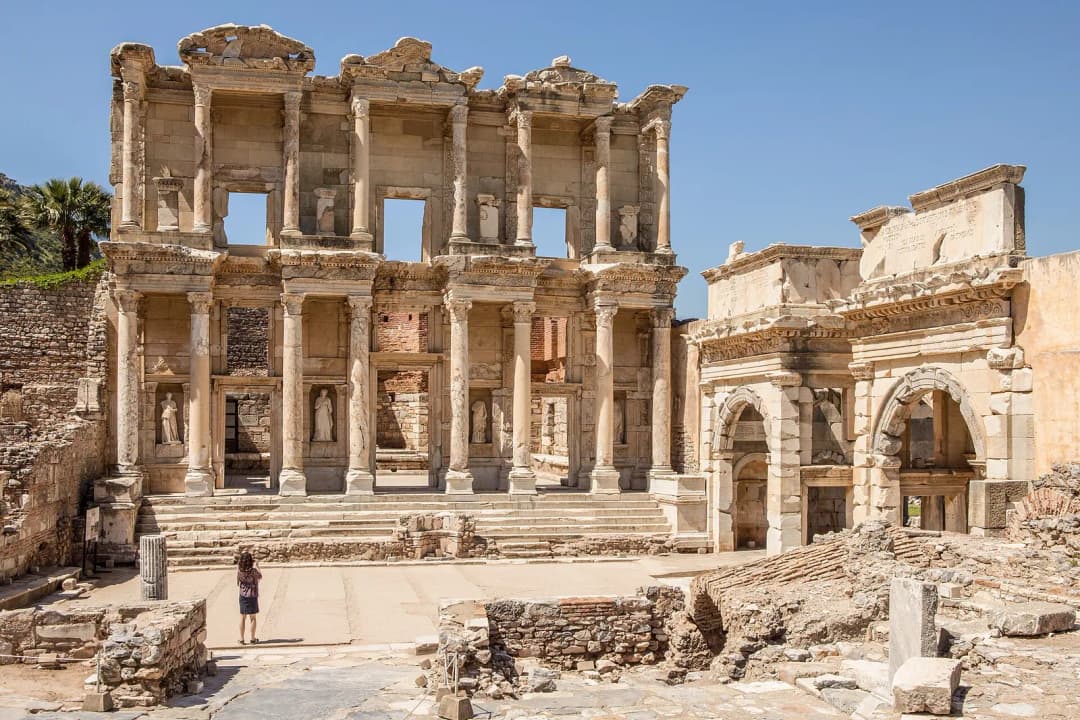
A full day is not enough for all of Ephesus, so choose: the Library of Celsus, Great Theatre and Terrace Houses, plus one add-on from Selçuk or Şirince. Alaçatı is 155 km from the site.
Ephesus from İzmir or the Çeşme peninsula: how much to attempt in a day
Ephesus is one of the largest ancient cities you can visit in Türkiye, and GoTürkiye notes that a full day is not enough to see the whole site. The realistic aim for a day trip is therefore a selection: the Library of Celsus, the Great Theatre and the Terrace Houses at the ruins, then one add-on from nearby Selçuk (the Basilica of St John or the museum) or the village of Şirince. Ephesus was added to the UNESCO World Heritage List in 2015, and the ruins are spread over a wide area because the city moved several times, so choose your stops before you arrive rather than on the spot.
What to prioritise at the ruins
- Library of Celsus: built in 125 AD in memory of Tiberius Julius Celsus Polemaeanus, governor of Roman Asia from 105 to 107 AD, who is buried in a sarcophagus beneath it. UNESCO records that the façade was rebuilt from original fragments between 1970 and 1978.
- Great Theatre: GoTürkiye says it is believed to be the largest in the ancient world and was later also used for gladiatorial fights.
- Odeon: built around 150 AD by Publius Vedius Antoninus and his wife, and estimated to have seated 1,500 people.
- Temple of Hadrian: dates to the 2nd century and was repaired in the 4th century. It has been reconstructed from surviving fragments, and the originals are kept in the Ephesus Archaeological Museum.
- Terrace Houses: homes of wealthy residents, with mosaics, frescoes and underfloor heating according to GoTürkiye. UNESCO singles out Terrace House 2 for its wall paintings, mosaics and marble panelling. Check at the site whether this area is open and whether it needs a separate ticket.
GoTürkiye says Ephesus became a Roman city in 133 BC and the capital of Asia Minor in 27 BC, and the site is large, so a simple rule helps: spend your longest stops on the sights where you can stand inside the structure (library, theatre, Terrace Houses) and treat the Odeon and the Temple of Hadrian as shorter pauses.
Selçuk: stops near the ruins
The town of Selçuk is near the ruins and adds several stops that suit a second half-day. The Temple of Artemis is counted among the Seven Wonders of the Ancient World, but only one column stands today; the Artemision stood at the foot of Ayasuluk hill in front of the city's earliest harbour. The Basilica of St John, near Selçuk, was built in the 6th century AD by Emperor Justinian I and is said to stand over the tomb of St John. GoTürkiye describes the House of the Virgin Mary and the Basilica and Tomb of St John as pilgrimage sites, and the Selçuk Museum holds artefacts from Ephesus and its surroundings. If you want to see finds from Ephesus, the museum in Selçuk is the natural complement to the ruins; GoTürkiye says the original Temple of Hadrian fragments are kept in the Ephesus Archaeological Museum.
Şirince: a slower end to the day
GoTürkiye describes Şirince as a village with a history dating back to the 5th century BC, known for fruit wines, vineyards and olive oil, with a moderate climate that allows year-round visits. Visitors can stay in restored historic houses. GoTürkiye suggests combining Şirince with day trips to İzmir, Kuşadası and Pamukkale but gives no travel times, so ask your host for the current journey time from Selçuk. Şirince works well as the last stop of the day, when you have finished with the ruins and want a place to eat and walk.
Three ways to shape the day
- Ruins-focused: Library of Celsus, Great Theatre and Terrace Houses, then the museum in Selçuk for the finds. Skip Şirince.
- Ruins and pilgrimage: the main ruins, then the Basilica of St John and the nearby House of the Virgin Mary.
- Ruins and village: the highlights of the site, then Şirince for fruit wines, olive oil and a quieter evening.
Whichever you choose, check the current opening hours, ticket arrangements and any closures at the official sites before you go; they change and are not covered here.
Getting there from İzmir Airport or the Çeşme peninsula
From İzmir Adnan Menderes Airport (ADB), which DHMİ places about 18 km from the city centre, there is a rail option worth knowing about: signs and a moving walkway lead from the International Arrivals floor to the İZBAN station, and İZBAN is a suburban rail system between Aliağa and Selçuk, with 41 stations over 136 km. That means the airport and Selçuk are on the same line, so check the current timetable and any change of trains before relying on it, and plan the last stretch from Selçuk to the ruins separately.
If you are staying on the Çeşme peninsula, the distance is the main factor: GoTürkiye gives 155 km from Alaçatı to Ephesus, so a day trip from the peninsula is a full outing in itself. The airport transfers themselves are about 95 km and 65 minutes to Çeşme and about 85 km and 58 minutes to Alaçatı. If you are choosing a base, Çeşme or Alaçatı: which Aegean base fits your trip compares them, and Çeşme and Alaçatı have their own pages. Flight status is monitored for airport pickups, and pickup timing may be adjusted based on the actual arrival time.
Questions visitors ask
Can I see Ephesus in one day?
You can see a selection. GoTürkiye says a full day is not enough to see the entire site, so decide in advance which highlights and which add-on (Selçuk or Şirince) you want.
Is the Temple of Artemis worth including?
It is counted among the Seven Wonders of the Ancient World, but only one column stands today, so treat it as a short stop rather than a main sight.
Can I reach Selçuk by rail from İzmir Airport?
İzmir Adnan Menderes Airport has an İZBAN station, and İZBAN runs between Aliağa and Selçuk. Check the current timetable and any change of trains before planning around it.
For transfers from İzmir Airport to the peninsula, see the route pages for Çeşme and Alaçatı.