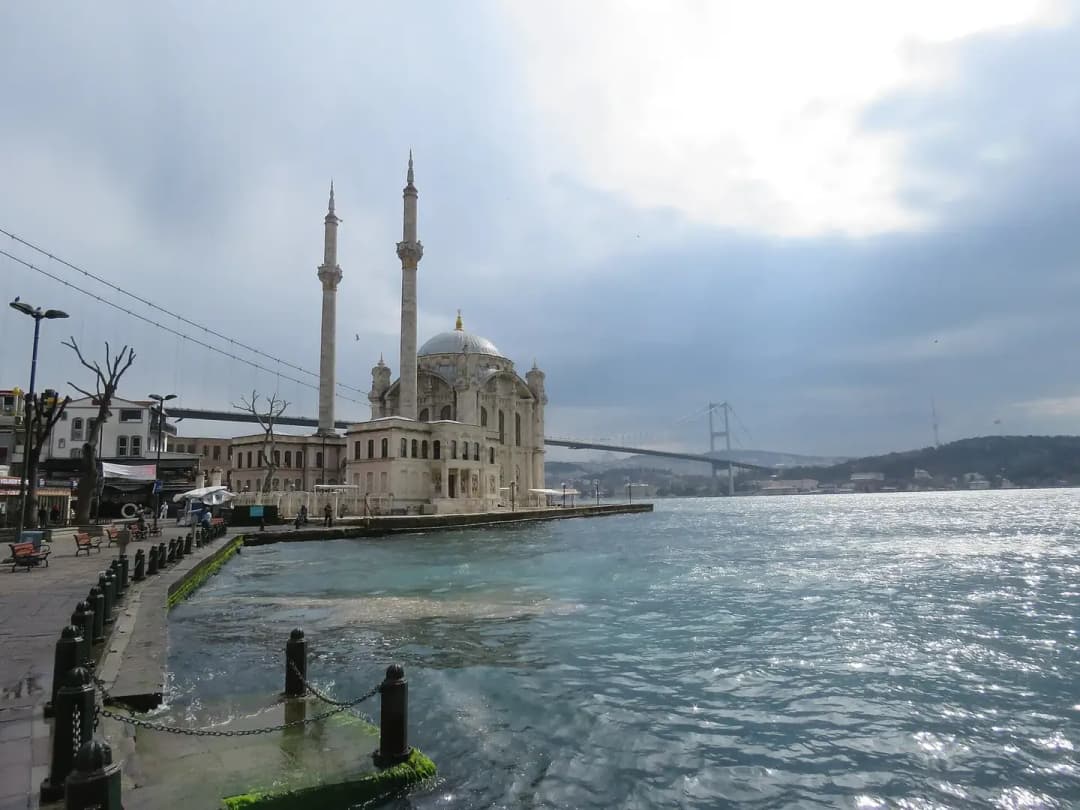
For half a day in Ortaköy, keep the visit compact: square first, Büyük Mecidiye Mosque and bridge view next, kumpir or waffles after, then Feriye Palace and Esma Sultan Mansion exteriors.
Half a day in Ortaköy works when you treat it as a compact Bosphorus plan rather than a checklist across the whole city: arrive at the square, see Büyük Mecidiye Mosque from the waterfront, frame the July 15 Martyrs Bridge behind it, eat kumpir or waffles, then look toward Feriye Palace and Esma Sultan Mansion before deciding whether to continue along the shore toward Beşiktaş. The decision rule is simple: keep Ortaköy for a few focused stops if you want architecture, a bridge view and street food in one place; choose a larger district plan such as Sultanahmet if your priority is a long sequence of museums and monuments.
The Half-Day Flow
Start in the square because it explains Ortaköy quickly. The mosque, the bridge, the waterfront and the food stalls sit close together, so you do not need a complicated route. Allow roughly half a day overall: spend the first part around the square and mosque, pause for kumpir or waffles, then use the remaining time for the bridge view and the Feriye and Esma Sultan exteriors. Walk first to the water-facing edge of Büyük Mecidiye Mosque, then step back into the square for the classic mosque-and-bridge composition. After that, use food as the pause in the middle of the visit: kumpir for something savoury, waffles for something sweet. Finish by looking at the waterfront palace and mansion exteriors nearby, then leave by ferry, bus, private transfer or a connection through Beşiktaş depending on where you are going next.
| Part of the visit | What to do | Why it belongs in a short plan |
|---|---|---|
| Square and waterfront | Get oriented around the mosque, stalls and Bosphorus edge. | It gives the clearest sense of Ortaköy's scale and atmosphere. |
| Büyük Mecidiye Mosque | See the Neo-Baroque exterior and, when appropriate, the bright interior. | The mosque is the architectural anchor of the neighbourhood. |
| July 15 Martyrs Bridge view | Use the bridge as the backdrop rather than trying to turn the visit into a bridge crossing. | The visual contrast brings the mosque and bridge together in one memorable view. |
| Kumpir and waffles | Choose one food stop in the square instead of trying to eat a full restaurant meal. | These are the local street-food signatures of the area. |
| Feriye and Esma Sultan exteriors | Look toward the waterfront palace and mansion as context after the square. | They extend the story from mosque-and-bridge to late Ottoman waterfront life. |
Start With The Mosque And The Bridge
Büyük Mecidiye Mosque is the centrepiece of the visit. Formally the Grand Imperial Mosque of Sultan Abdülmecid I, it replaced earlier religious buildings on the same waterfront site: the Mahmud Ağa Mosque from the 1720s was destroyed during the 1731 Patrona Halil revolt, and the later Mehmed Kethüda Mosque was badly damaged over time. The current mosque was built between 1853 and 1856 by the Ottoman-Armenian father-and-son architects Garabet Amira Balyan and Nigoğayos Balyan, who also worked on nearby Dolmabahçe Palace.
The mosque is useful for a short visit because its architecture reads clearly from outside. Its Neo-Baroque composition, tall arched windows, single dome and U-shaped imperial apartment facing the northern side make it feel different from the denser mass of classical Ottoman mosques. If you enter, do it respectfully and keep the visit flexible; if visiting arrangements are not suitable at the moment you arrive, the exterior and waterfront setting still support the plan.
The bridge behind the mosque is officially the July 15 Martyrs Bridge, long known as the Bosphorus Bridge. It was approved in 1957, designed in 1968 by Freeman Fox and Partners, and built between 1970 and 1973 as the first modern suspension bridge across the Bosphorus. Its figures explain why it dominates the view: 1,560 m long, 33.40 m wide at deck level, with 165 m towers and 64 m clearance above the water. In a short Ortaköy visit, the bridge is not a separate excursion; it is the backdrop that makes the square memorable.
Make Kumpir Or Waffles The Middle Of The Visit
Ortaköy is closely associated with kumpir and waffles. Keep that stop in the middle of the visit rather than at the very end, because the food stalls are part of the square's rhythm. Kumpir is a stuffed baked potato; waffles are the sweet counterpart. The point is not to over-plan the meal but to leave space for the square itself: people moving between the waterfront, the mosque, the stalls and the surrounding lanes.
If you are arriving after a flight, this is also where Ortaköy works well: the plan does not demand museum-style concentration. It gives you a waterfront setting, a clear architectural focal point and an easy food break. If you are connecting from another district, keep the food stop light enough that you can still continue to Beşiktaş, back toward your hotel, or onward to another evening plan.
Add The Waterfront Palace Exteriors
After the square, look along the shore for the late Ottoman waterfront layer. Feriye Palace was commissioned in 1871 by Sultan Abdülaziz and designed by Sarkis Balyan to house extended members of the Ottoman royal family. Its name means secondary or auxiliary, reflecting its relationship to the Dolmabahçe and Çırağan palace environment. The complex is also tied to a difficult imperial episode: Sultan Abdülaziz was found dead there on June 4, 1876, after being deposed. After the 1924 abolition of the Caliphate, the buildings were used for education, and in 1992 they were handed to Galatasaray University.
Beside the mosque, Esma Sultan Mansion adds another layer. Designed by Sarkis Balyan and completed in 1875 as a wedding gift for Esma Sultan, daughter of Sultan Abdülaziz, it later served as a Greek school, tobacco warehouse and coal depot before a 1975 fire left it gutted. In the 1990s, The Marmara Hotels chain acquired the property and adapted it by keeping the original brick exterior walls while inserting a modern glass structure inside. For a half-day visitor, these buildings are mainly context from outside: they make Ortaköy more than one square and one photograph.
A Compact History Of Ortaköy
Ortaköy has older names behind its modern identity. In antiquity it was known as Arhias or Arheion, then as Agios Phocas in the Byzantine period, linked to a monastery built under Emperor Basil I and dedicated to Saint Phocas, Bishop of Sinope. Under Ottoman rule the village became Mesachori, meaning Middle Village, which is the root of the Turkish name Ortaköy.
The first Turkish population settled here in the mid-16th century under Süleyman the Magnificent, and a significant Sephardic Jewish population arrived in the 17th century. For centuries, Muslim Turks, Greek Orthodox Christians, Armenian Christians and Sephardic Jews lived close together. That layered religious landscape is still visible through the neighbourhood's mosque, Greek church, Armenian church and synagogue. Emigration to Israel after 1948 and the 1955 Istanbul Pogrom changed the demographic balance, but the buildings remain part of the area's cultural memory.
Getting There From Istanbul Airports
From Istanbul Airport (IST), the Istanbul Airport to Ortaköy route is about 38 km and roughly 48 minutes by the routing estimate. From Sabiha Gökçen Airport (SAW), the Sabiha Gökçen to Ortaköy route is about 42 km and roughly 45 minutes by the routing estimate. Traffic can change the real arrival time, especially around the Bosphorus crossings, so allow extra time when your plan is tied to a flight, dinner booking or hotel check-in.
A private transfer is one option: door-to-door in a Mercedes Vito or Mercedes Sprinter vehicle (the exact model is not guaranteed), booked from the pickup and drop-off you enter, with the price shown before you pay. Flight status is monitored for airport pickups, and pickup timing may be adjusted based on the actual arrival time. If your hotel is not directly in Ortaköy, compare the exact address with nearby route pages; for example, Istanbul Airport to Beşiktaş and Istanbul Airport to Sultanahmet describe different destination patterns.
Public Transport And Local Connections
There is no metro or tram station in Ortaköy square. For Istanbul Airport, Istanbul Airport's website lists the M11 Gayrettepe - Istanbul Airport metro and says Havaist runs 11 routes between the airport and the city centre, with named stops including Taksim Square, Beşiktaş Square, Zincirlikuyu Metrobus and 4. Levent; it also lists İETT airport routes. For Sabiha Gökçen Airport, Metro Istanbul lists the M4 Kadıköy - Sabiha Gökçen Airport line with 23 stations and a 52 min journey duration, including interchanges at Kadıköy, Ayrılık Çeşmesi, Ünalan, Kozyatağı and Pendik.
Those rail and bus facts help you plan the airport side of the journey, but the last step to Ortaköy still needs checking. For ferries, check Şehir Hatları; for buses, check İETT; for airport buses, check the airport or operator before travelling. If you are already in central Istanbul, Beşiktaş is often the practical neighbour to think about, because Ortaköy sits within that Bosphorus-side urban flow.
Where To Stay For An Ortaköy Half-Day
Staying in Ortaköy makes sense if you want the square, waterfront and evening atmosphere close to your door. Staying in Beşiktaş can be more flexible if you want a wider set of restaurants, ferry links and hotel choices nearby, while Ortaköy remains a focused outing along the shore. Staying in Sultanahmet suits travellers who want their first priority to be the historic peninsula, with Ortaköy treated as a separate Bosphorus visit rather than the centre of the trip.
For an arrival day, choose accommodation by how much energy you expect to have after the flight. Ortaköy is gentle if your plan is mainly waterfront, food and one major view. Beşiktaş gives more onward options. Sultanahmet puts a different kind of Istanbul first. For transfer and booking options, use the relevant Istanbul Airport, Sabiha Gökçen Airport, IST to Ortaköy and SAW to Ortaköy pages.